


CCP 2026: CHF 290,000 to accelerate circular construction
Table of Contents
The CCP 2026 at a Glance
Are you a company based in the canton of Fribourg with an innovative, impactful, and scalable solution to transform the construction sector and reduce its environmental footprint? We provide you with the tools to take action.
In 2026, the canton of Fribourg is launching the second edition of its Thematic Call for Collaborative Projects (CCP), introduced in 2025 under the framework of the New Regional Policy (NRP).
Goal: To support collaborative projects between companies aimed at accelerating the transition toward circular and eco-designed construction, in response to environmental and regulatory challenges in the sector.
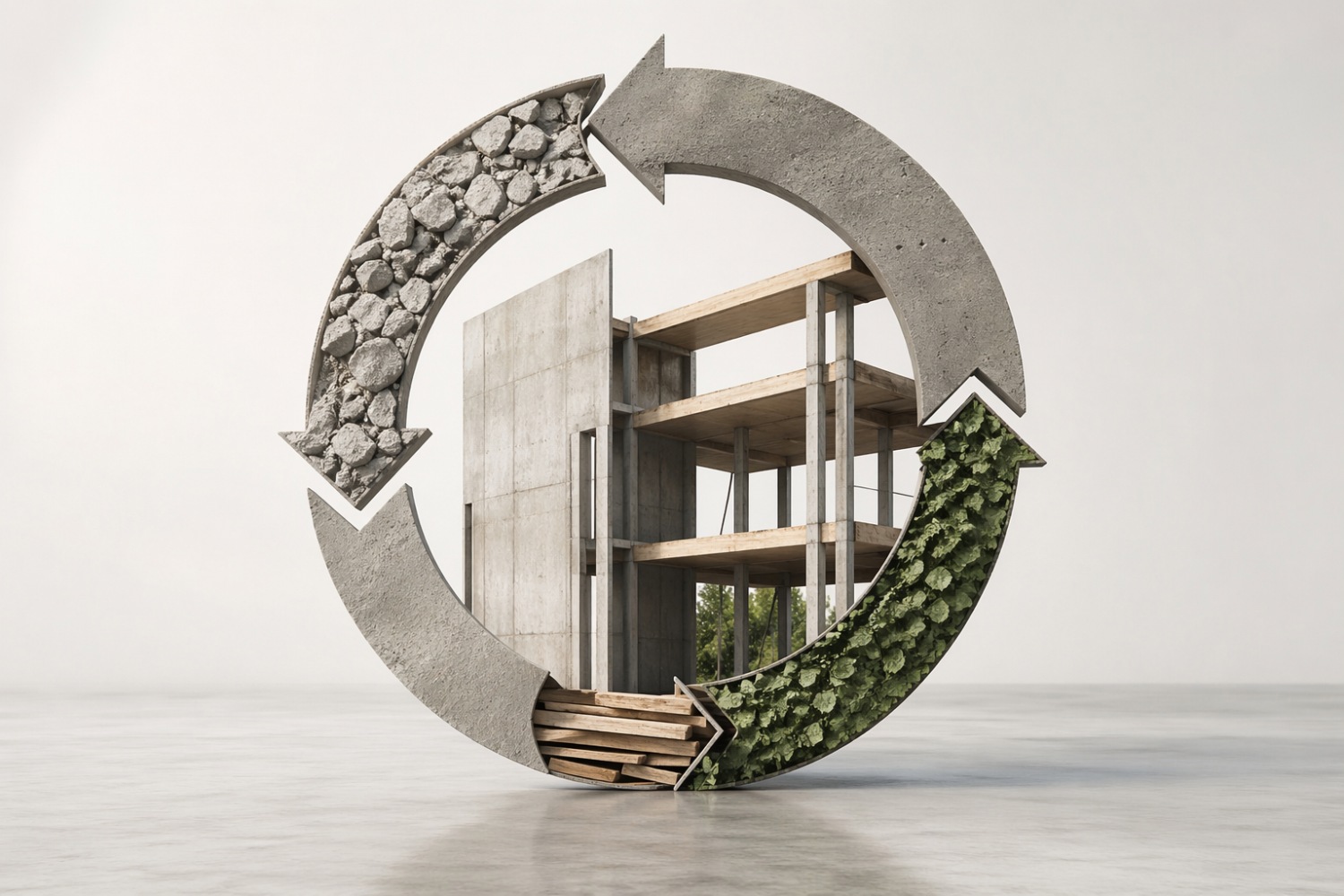
Theme for 2026: Rethinking construction: toward circular and eco-designed systems.
Deadline for submitting project outlines: September 9, 2026.
> Link to the April 28, 2026 news (in French)
> Link to the April 28, 2026 news (in German)
What Is a CCP?
A Call for Collaborative Projects (CCP) is an economic development instrument of the canton of Fribourg, funded through the New Regional Policy (NRP).
It is aimed at groups of companies seeking to implement innovative solutions in response to a challenge identified at the cantonal level. The CCP fosters inter-company collaboration and the development of regional value chains.
Eligibility requirement: The project must involve at least three companies, a majority of which must be based in the canton of Fribourg. Collaboration with an academic partner is possible and encouraged but not mandatory.
Selected projects may receive financial support of up to CHF 290,000, covering a maximum of 65% of the total project budget. Participating companies must cover the remaining share, including at least 10% in cash and 25% as in-kind contributions.
Goals of the 2026 CCP
The 2026 CCP supports the development of collaborative solutions aimed at reducing the environmental footprint of the construction sector, particularly from the design phase onward.
The sector is facing increasing environmental requirements, notably linked to the evolution of the Model Energy Regulations of the Cantons (MOPEC), which foresees the introduction of greenhouse gas emission thresholds as well as limits on embodied energy by 2029.
Projects should propose innovative approaches, particularly by reducing embodied energy and promoting material circularity: integration of bio-based or recycled materials, design of disassemblable systems, development of digital tools (material passports, digital twins) to improve traceability, or solutions facilitating resource reuse, such as material banks.
Projects must address at least one of the following goals:
- Design of modular and disassemblable systems enabling reuse
- Development of digital tools for material traceability and environmental impact
- Optimization of the environmental performance of products, particularly regarding embodied energy
- Development of solutions promoting material circularity
In addition, each project must demonstrate measurable impact on the environmental footprint of buildings and infrastructure, while maintaining economic competitiveness.
Target Groups
The following list is indicative and non-exhaustive:
- Construction and prefabrication companies
- Producers of materials (concrete, wood, insulation, etc.)
- Providers of digital solutions and traceability tools
- Architects, engineering and planning firms
- Deconstruction and recycling stakeholders
- Companies active in bio-based or recycled materials
- Energy and environmental performance stakeholders
- Research centers and academic partners
- Public institutions and spatial planning stakeholders
- Producers, distributors, retailers, manufacturers
Six-Step Procedure
- Step 1: Launch of the project call
Submission of project outlines by September 10, 2025 - Step 2: Selection of the best outlines
- Step 3: Preparation of the funding application
With support from INNOSQUARE - Step 4: Evaluation by an expert panel
Assessment of relevance, feasibility, and impact - Step 5: Grant approval decision
By the NRP Committee - Step 6: Signing of the NRP funding agreement
How to Participate
Interested in submitting a project?
Please download the Word form below and send it by email by September 10, 2025, to the following address: nicolas.huet@hefr.ch.
> Download form in English
> Download form in French
> Download form in German
Contact
Nicolas Huet, Head of INNOSQUARE, nicolas.huet@hefr.ch
Partners